GEOTECHNICALENGINEERING
SURREY
HomeGeophysicsSeismic tomography (refraction/reflection)

Seismic Tomography in Surrey, BC: Refraction & Reflection Surveys

Technical studies that support your project.

LEARN MORE

Surrey isn't one geological story. South Surrey and White Rock sit on glacial till and Vashon drift, while Newton and Cloverdale hit Fraser River silts and organic deposits just a few meters down. That contrast matters when you're planning a foundation or mapping bedrock. We use seismic tomography to image the subsurface without guessing. Refraction gives us a velocity model for rippability and depth to competent ground. Reflection resolves stratigraphy that refraction misses. A recent project in Clayton Heights needed both methods because a buried channel filled with compressible clay was invisible to standard site investigation. We mapped it in half a day. The MASW survey can complement this when shear wave velocity profiles are required for NBCC site classification.

A velocity contrast doesn't always mean a material change. In Surrey's glacial terrain, it often means a change in density within the same unit.
Our service areas

Our approach and scope

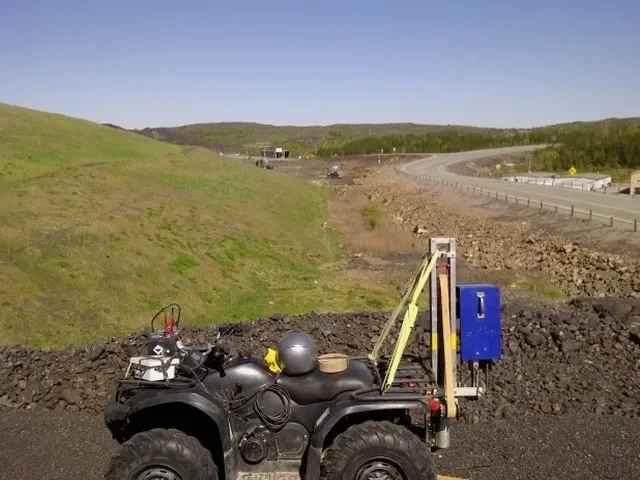
In Surrey, we often see weathered glacial sediments that look competent but aren't. A visual inspection of an excavation wall tells you nothing about seismic velocity contrasts 15 meters down. Refraction tomography maps those contrasts across a linear array. We use 24 or 48 geophone spreads with a sledgehammer or weight drop source. First-arrival picks feed a ray-tracing inversion that produces a 2D P-wave velocity section. Reflection surveys add higher resolution where needed. We deploy a landstreamer or planted geophones with a faster sampling rate, processing the data through standard CMP workflows. The result is a depth section showing stratigraphic boundaries and structure. This is practical geophysics for real construction problems—not academic research.
Seismic Tomography in Surrey, BC: Refraction & Reflection Surveys
Technical reference — Surrey

Local ground factors

Surrey's split personality—glacial uplands in the south, floodplain deposits in the north—creates a specific risk: assuming uniform ground conditions across a site. We've seen excavation plans fail because a refraction line run only on the access road missed a buried peat lens under the building footprint. The rainy winter months add another complication. Saturated near-surface soils attenuate high-frequency energy, reducing resolution in reflection data. We schedule surveys carefully and adjust source energy to compensate. The biggest risk isn't geophysical noise—it's an under-scoped survey. Running one short line when the site has lateral variability gives a false sense of certainty. We'd rather tell you the data is ambiguous than give you a pretty but wrong tomogram.

Need a geotechnical assessment?

Reply within 24h.

Email: [email protected]

Reference standards

NBCC 2020 (National Building Code of Canada) for seismic site classification, CSA A23.3-19 Design of Concrete Structures (geotechnical input parameters), ASTM D5777-18 Standard Guide for Using the Seismic Refraction Method, ASTM D7128-18 Standard Guide for Using the Seismic Reflection Method, BC Building Code 2024 (adopted NBCC with provincial amendments)

Technical parameters

ParameterTypical value
MethodSeismic refraction and/or reflection tomography
Source typeSledgehammer, weight drop, or buffalo gun (site-dependent)
Array length46 m to 230 m (24-48 geophones at 2-5 m spacing)
Depth of investigationTypically 15-20% of array length for refraction; target-dependent for reflection
P-wave velocity range300 m/s (loose fill) to >4000 m/s (competent bedrock)
Data output2D velocity tomogram, interpreted depth section, rippability log
Data formatSEG-2, SEG-Y, PDF report, DXF overlay for CAD integration
Reporting standardNBCC 2020 seismic site classification (Vs30 proxy via correlation)

Frequently asked questions

How much does a seismic tomography survey cost in Surrey?

Most projects fall between CA$3,280 and CA$7,940. The spread depends on array length, whether you need refraction only or refraction plus reflection, how many lines we run, and site access logistics. A single short refraction line on flat ground costs less than a multi-line reflection survey through blackberry bushes. We'll give you a fixed price after we see the site and understand the target depth.

What's the difference between seismic refraction and reflection for my project?

Refraction gives you a velocity model—great for rippability and depth to bedrock. Reflection gives you a stratigraphic image—better for mapping layers, channels, and structure. Many Surrey sites benefit from both. Refraction finds the top of competent material. Reflection tells you what's inside it.

How deep can you see with these methods?

Depth depends on array length and source energy. A 115-meter refraction spread typically images 20 to 25 meters deep. Reflection can go deeper with a stronger source. In Surrey's glacial sediments, we've mapped bedrock at 40-plus meters using a weight drop source and long offsets.

Can seismic data replace boreholes?

No. Seismic gives you continuous spatial coverage; boreholes give you point-specific material identification. They work together. We use tomography to position boreholes intelligently and to interpolate between them. A velocity model alone doesn't tell you if that fast layer is till or sandstone—but it tells you where to drill.

What site access do you need for a seismic survey in Surrey?

We need a clear linear path for the geophone spread—typically 50 to 250 meters long. A sledgehammer source needs firm ground; a weight drop can work on pavement or gravel. Trees, buildings, and buried utilities complicate the layout. We scout every site beforehand and adjust the array to fit what's actually there.

Location and service area

We serve projects in Surrey and surrounding areas.

View larger map