GEOTECHNICALENGINEERING
SURREY
HomeIn-Situ TestingField density test (sand cone method)

Field Density Testing (Sand Cone Method) in Surrey, BC

Technical studies that support your project.

LEARN MORE

In Surrey we encounter a wide mix of subgrade materials that make compaction control anything but routine. From the dense glacial till over the upland plateaus of Fleetwood to the soft, compressible silts near the Serpentine and Nicomekl floodplains, every site tells a different story. We've seen beautifully graded gravel borrow turn to soup after a week of Lower Mainland rain, and stiff clay that looked perfect on the lab report but failed in the field because of hidden layering. That's why we run the sand cone density test per ASTM D1556 as our primary field check. It isn't the fastest method, but when the BC Building Code and the local authority ask for proof that your structural fill meets 95% or 98% of Standard Proctor, the sand cone gives an answer that stands up to scrutiny. Before we mobilize to site, we often review borehole logs from SPT drilling to understand what the native formation looks like at depth, so we're not just testing the fill but also confirming it's placed on competent ground.

The sand cone doesn't lie: if that last pass with the smooth drum didn't achieve spec, the numbers will show it before the next lift covers the problem.
Our service areas

Our approach and scope

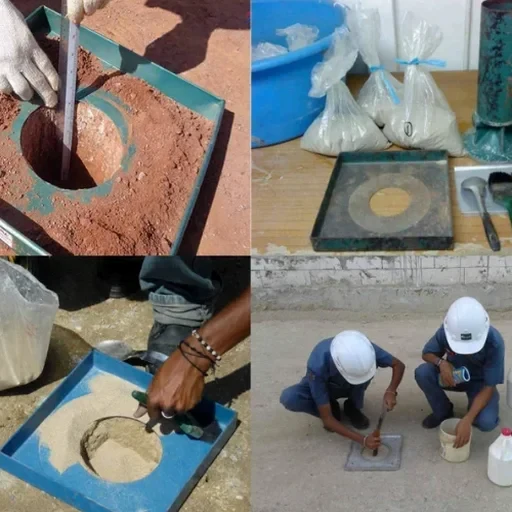
The kit we bring to Surrey sites is straightforward but demands a careful operator. A 165 mm diameter base plate sits flat on the prepared surface, and we carefully hand-excavate a test hole through the full lift thickness, typically 150 to 300 mm deep depending on the spec. All the excavated soil goes straight into a sealed container because losing even a few grams of fines during a damp Surrey morning skews the moisture content and the dry density number. We pour Ottawa sand, calibrated against our NIST-traceable standard, through a cone valve into the hole, letting it fill every little irregularity in the sidewalls. The volume of sand consumed divided by its calibrated bulk density gives the in-place volume, and the field wet density follows directly. Back at our Surrey laboratory, we oven-dry a representative split of the soil to ASTM D2216, compute the dry density, and compare it to the proctor curve. On a typical day we'll run 15 to 20 sand cone points across multiple lots, and the numbers either give the contractor the green light or flag a section for re-rolling before the lift gets buried.
Field Density Testing (Sand Cone Method) in Surrey, BC
Technical reference — Surrey

Local ground factors

The 2020 BC Building Code, supplemented by the Surrey Engineering Department's standard specifications, mandates compaction verification on all engineered fill placed under footings, slabs-on-grade, and roadway subbases. Skipping field density checks on a Surrey project isn't just a code violation: it's a direct path to differential settlement that cracks partitions, binds doors, and damages hardscaping within the first two wet seasons. We've pulled core samples from failed garage slabs in Clayton Heights where the fill underneath tested at barely 82% of Standard Proctor, and the repair bill ran well into five figures. The biggest single risk factor in Surrey is moisture variation. Fill placed at 2% above optimum during a dry August afternoon can look perfect on the gauge, but the same material swells and loses strength after the November rains saturate the subgrade if the compaction wasn't locked in. Our sand cone tests capture that moment-in-time density plus the field moisture content, giving the geotechnical engineer the data needed to decide whether the lift stays or gets scarified, dried back, and re-compacted.

Need a geotechnical assessment?

Reply within 24h.

Email: [email protected]

Reference standards

ASTM D1556 / D1556M – Standard Test Method for Density and Unit Weight of Soil in Place by Sand-Cone Method, ASTM D698 – Standard Test Methods for Laboratory Compaction Characteristics of Soil Using Standard Effort, BC Building Code 2018 (Division B, Part 4 – Structural Design), MMCD (Master Municipal Construction Documents) Section 31 23 33 – Trenching, Backfilling and Compacting

Technical parameters

ParameterTypical value
Test standardASTM D1556 / D1556M
Base plate diameter165 mm (6.5 in)
Typical test depth150–300 mm per lift
Calibration sandGraded Ottawa sand, bulk density 1.45–1.60 g/cm³
Field density reported as% of Standard Proctor (ASTM D698) or Modified Proctor (ASTM D1557)
Minimum test frequency1 per 500 m² per lift or as per project spec
Lab turnaroundSame-day moisture, full report within 24 hours

Frequently asked questions

Why is the sand cone method still used in Surrey when nuclear gauges are faster?

The sand cone is a direct measurement of volume and mass. It doesn't rely on radiation physics or an empirical calibration curve that can drift with changes in soil chemistry, which matters in Surrey where fill sources range from granitic Fraser River sand to organic-rich deltaic silt. Municipal inspectors here often request a minimum percentage of sand cone tests alongside nuclear gauge results precisely because the sand cone is considered the referee method. If there's ever a dispute about a failed lift, the sand cone number is the one that holds up.

How deep can you test with the sand cone?

Typically we test through a single compacted lift, which is 150 to 300 mm thick for most structural fill in Surrey. The method works well up to about 300 mm depth. If the fill has large cobbles or the lift is thicker than that, we discuss alternative approaches, but for standard residential and commercial pad prep in this area, one lift at a time is the norm.

What does a field density test cost in Surrey?

For a standard sand cone test with same-day moisture and a written report, the cost ranges from CA$150 to CA$210 per point depending on the number of points on the same visit and the travel distance within Surrey. Projects with 10+ tests on one mobilization typically land at the lower end of that range.

How soon after compaction can we get results?

We provide the field wet density and the percent compaction verbally or by text before we leave site, as long as we have the Proctor curve on hand. The official signed report with dry density, moisture content, and QA/QC summary follows within 24 hours. On critical lifts where the concrete pour is scheduled the next morning, we can expedite the report the same evening.

Location and service area

We serve projects in Surrey and surrounding areas.

View larger map