GEOTECHNICALENGINEERING
SURREY
HomeSlopes & WallsActive/passive anchor design

Active and Passive Anchor Design for Deep Excavations in Surrey, BC

Technical studies that support your project.

LEARN MORE

Surrey has grown from scattered agricultural settlements along the Fraser River into one of Metro Vancouver's largest cities, now pushing past 600,000 residents. That growth means excavation depths are increasing too—underground parking structures, utility corridors, and commercial basements are now routine. The challenge here is not just the depth but the ground itself: thick sequences of Vashon till underlain by advance-phase glaciomarine and glaciofluvial deposits that behave very differently from one block to the next. Designing a shoring system without a thorough understanding of how these soils interact with post-tensioned anchors can turn a straightforward dig into an expensive delay. When we plan an anchor scheme, we start with the stratigraphy, assessing whether passive resistance in the till can carry temporary loads or whether the design requires active strand anchors with locked-off prestress to limit lateral movement in overconsolidated silts and clays. This geological nuance is what separates a slope stability assessment that merely checks a box from one that actually reflects the site's real behavior under load.

An anchor design that does not account for the transition between Vashon till and underlying glaciomarine silts is not a design—it is a gamble on wall performance.
Our service areas

Our approach and scope

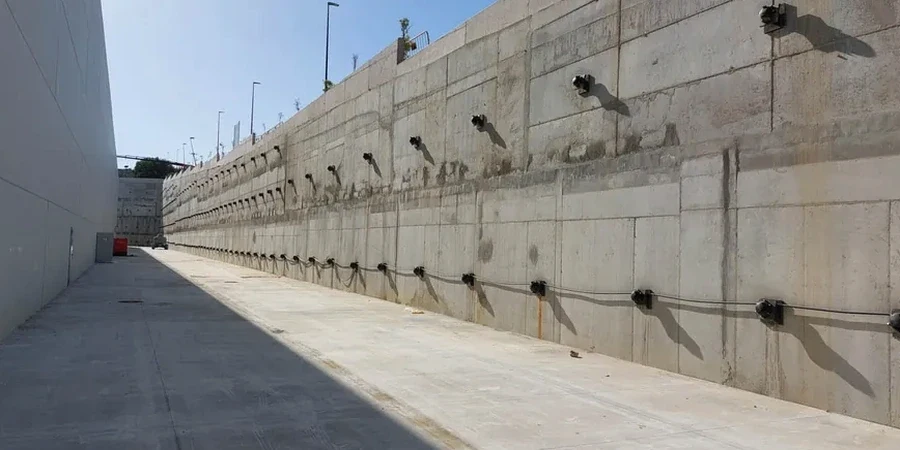
The most common mistake we see in Surrey is assuming that a single row of grouted tiebacks will perform identically across an entire site when the soil profile changes by two meters of elevation. A contractor will drill into stiff glacial till on the west side of the parcel and encounter soft, normally consolidated deltaic silts on the east side, yet the anchor bond length stays the same. That mismatch between design assumption and ground truth is where wall deflections begin. Our design methodology anchors itself in site-specific data—we correlate CPT test results with laboratory shear strength to define the bond zone in each soil unit, not just the average. For active anchors, we calculate the unbonded length to place the fixed anchor behind the critical failure surface, typically at 45 to 60 degrees from horizontal depending on the retained height. For passive anchors, we rely on the development of resistance through deformation, which works well in the dense till but requires careful coordination with the shoring contractor to confirm that the wall system can tolerate the displacement needed to mobilize the design load. We also specify encapsulation in corrugated sheathing where groundwater is aggressive, a detail that is often skipped but matters when sulfate concentrations in Surrey's groundwater exceed 150 ppm.
Active and Passive Anchor Design for Deep Excavations in Surrey, BC
Technical reference — Surrey

Local ground factors

Surrey sits at roughly 49.19 degrees north, in one of Canada's most active seismic zones. The Cascadia subduction zone and shallower crustal faults put the city at risk for long-period ground motion that is particularly punishing on restrained shoring systems. A 2018 study by the Geological Survey of Canada estimated a 30% probability of a significant crustal earthquake in southwestern British Columbia within the next 50 years. For anchored walls, that means the design cannot stop at static earth pressures. We must evaluate the additional dynamic load component on each anchor level, checking that the unbonded length provides enough elastic stretch to accommodate seismic displacement without exceeding the strand's yield. In the soft alluvial pockets near the Serpentine and Nicomekl rivers, the risk pathway doubles: first, a reduction in passive resistance due to cyclic softening, and second, the potential for anchor creep if the grout-to-ground bond is placed in liquefiable silts. We address this by deepening the fixed anchor into competent till or by switching to a retaining walls solution where ground conditions are too marginal for reliable anchor performance. Neither option should be decided without a site-specific seismic hazard assessment tied to the NBCC spectral acceleration values.

Need a geotechnical assessment?

Reply within 24h.

Email: [email protected]

Reference standards

NBCC 2020 (National Building Code of Canada) – Seismic hazard and structural design provisions, CSA A23.3:19 – Design of concrete structures, including anchorages and prestressing steel, ASTM A416/A416M – Standard specification for low-relaxation, seven-wire steel strand for prestressed concrete, PTI DC35.1-14 – Recommendations for prestressed rock and soil anchors

Technical parameters

ParameterTypical value
Typical design life (temporary anchors)18 to 24 months per NBCC
Typical design life (permanent anchors)50+ years with double corrosion protection
Strand grade per CSA A23.31860 MPa (Grade 270)
Common bond length in glacial till4.5 to 9.0 m
Typical unbonded lengthMinimum 4.5 m or beyond failure wedge
Lock-off load for active anchors70 to 80 % of design load
Proof load during acceptance testing133 % of design load (temporary) / 150 % (permanent)
Maximum anchor spacing1.8 to 2.4 m horizontal, per geotechnical recommendation

Frequently asked questions

What is the difference between active and passive anchors in a shoring system?

Active anchors are post-tensioned and locked off against the wall after installation, applying a precompression to the soil mass that controls lateral movement from the start. Passive anchors are not prestressed; they develop resistance only when the wall begins to deflect and the anchor elongates, so they are better suited to ground conditions where some controlled movement is acceptable and the soil can provide reliable passive reaction.

How deep into the glacial till do anchors typically need to be bonded in Surrey?

It depends on the design load and the till's consistency, but we generally see bond lengths between 4.5 and 9.0 meters when the fixed anchor is placed in dense Vashon till with an SPT N-value above 40. In weaker glaciomarine silts, we either extend the bond length further or move the fixed anchor deeper until we reach competent material.

What is the cost range for an active anchor design package in Surrey?

For a typical project involving between 30 and 80 anchors, the design and load-test specification package generally falls between CA$1,620 and CA$4,680, depending on the number of anchor levels, the complexity of the soil stratigraphy, and whether seismic analysis is required.

Do anchors require corrosion protection in Surrey's soils?

Yes, and more than the minimum. Groundwater in several parts of Surrey carries elevated sulfate concentrations, and the winter de-icing salts that percolate through urban fills add chloride. For permanent anchors, we specify double corrosion protection with a corrugated plastic sheath and post-grouting. For temporary anchors with a service life under 24 months, a single encapsulation may suffice, but we always validate with water chemistry data from the site investigation.

How do you verify that an installed anchor will perform as designed?

Every anchor undergoes either a performance test or a proof test, depending on its function and whether it is temporary or permanent. We apply a stepped load cycle up to 133% of the design load for temporary anchors and 150% for permanent anchors, measuring creep movement at each step. The acceptance criterion is based on the residual movement and the elastic rebound, compared against the theoretical elongation of the unbonded length.

Location and service area

We serve projects in Surrey and surrounding areas.

View larger map