GEOTECHNICALENGINEERING
SURREY
HomeInvestigationExploratory test pit

Exploratory Test Pit Excavation in Surrey, BC

Technical studies that support your project.

LEARN MORE

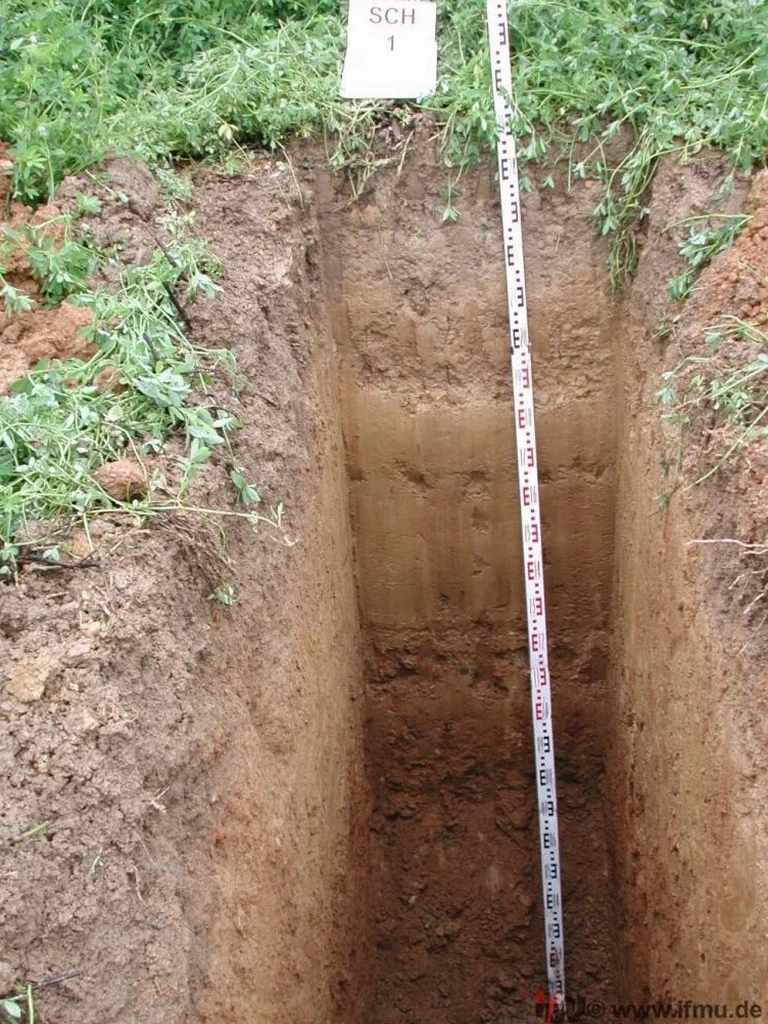
A Caterpillar 308 compact excavator with a 24-inch smooth bucket cuts through the topsoil behind a commercial lot in Surrey’s Newton district, opening a 3.5-metre-deep section into the Vashon till that underlies much of the city. The excavation exposes a sequence of stiff silty clay over dense glacial drift, with groundwater seeping in at the contact zone roughly two metres below grade. In Surrey, where the Pleistocene and Holocene deposits of the Fraser Lowland can shift from soft compressible silts to hard lodgement till within a single property, an exploratory test pit gives the geotechnical team a direct view of layering, moisture conditions, and excavation stability that no borehole log can fully reproduce. The field crew photographs the face, records stand-up time, and collects bulk disturbed samples for index testing back at the ISO 17025-accredited laboratory, building a visual record that informs footing design, utility trench safety, and construction-phase decisions. For projects near the Nicomekl or Serpentine River corridors, where organic peat layers complicate bearing conditions, test pit data often triggers the need for complementary in-situ permeability testing to evaluate drainage before foundation excavation proceeds.

A single test pit wall exposes more about Surrey’s glacial stratigraphy than a dozen split-spoon samples ever could.
Our service areas

Our approach and scope

In Surrey, the practical reality is that many sites in the South Newton and Cloverdale uplands encounter a thin crust of weathered till that masks softer underlying sediments—something you only catch when the excavator bucket breaks through that crust and the sidewall material changes colour and consistency within a vertical metre. A properly logged test pit captures these transitions far more vividly than SPT blow counts alone, which is why the field sheets include sketches of mottling, oxidation seams, and cobble lenses that later anchor the geotechnical model. Depth capacity typically reaches 4.3 metres in open cut with a benched excavation, though shallower pits are common where the water table sits high, as it does across much of Surrey between October and April. The team records soil type, moisture, consistency, and any shear planes or slickensides observed on the pit walls. When the investigation targets load-bearing strata for shallow foundations, the logging is cross-referenced with a plate load test conducted at the pit bottom to confirm modulus of subgrade reaction directly on the exposed bearing surface. For sites where the till transitions into Fraser River sand, a grain-size analysis on the bulk sample helps classify the material and flag potential liquefaction susceptibility under seismic loading.

Exploratory Test Pit Excavation in Surrey, BC
Technical reference — Surrey

Local ground factors

Surrey sits within the highest seismic hazard zone in Metro Vancouver, with a 2% in 50-year probability of exceeding 0.82g short-period spectral acceleration on Class C soils according to the National Building Code of Canada 2020 seismic hazard maps. An exploratory test pit that reveals loose saturated sand beneath a dense till cap signals a potential liquefaction hazard that can fundamentally change the foundation concept from shallow spread footings to a deep pile solution. Worse, pits opened near the Serpentine River floodplain frequently encounter compressible organic silts that consolidate unevenly under load, producing differential settlement that cracks partition walls and binds doors within the first five years of occupancy. The pit face also exposes relic shear surfaces in the overconsolidated till—features that indicate ancient slope movement and demand a stability reassessment before excavation proceeds. Missing these indicators because the investigation relied solely on disturbed borehole samples is a costly gamble in a city where the subsurface changes faster than the zoning map.

Need a geotechnical assessment?

Reply within 24h.

Email: [email protected]

Reference standards

NBCC 2020 Part 4 (Seismic Hazard and Foundation Requirements), CSA A23.3:19 (Design of Concrete Structures, referenced for exposure classification), ASTM D2488 (Standard Practice for Description and Identification of Soils — Visual-Manual Procedure), ASTM D4403 (Standard Practice for Field Logging of Subsurface Explorations), WorkSafeBC OHS Regulation Part 20 (Excavation and Trenching Safety)

Technical parameters

ParameterTypical value
Maximum practical depth (open cut)4.3 m (benched at 1.2 m intervals)
Bucket width610 mm (smooth edge, toothless for face logging)
Excavator class8-tonne compact (Cat 308 or equivalent)
Stand-up time monitoringLogged at 15, 30, and 60 minutes post-excavation
Sampling intervalEvery stratigraphic change or max 1.0 m vertically
Groundwater observationDepth to seepage and stabilized level after 20 min
Applicable standardASTM D2488 (visual-manual) and NBCC 2020 Part 4

Frequently asked questions

How deep can a test pit go in Surrey’s soil conditions?

In the compact glacial till of Surrey’s upland areas, an 8-tonne excavator can reliably reach 4.0 to 4.3 metres with a benched open cut. Near the Serpentine and Nicomekl floodplains, where groundwater is often within 1.5 metres of the surface, practical depth is usually limited to 2.5 to 3.0 metres before inflows slow progress and sidewall sloughing becomes a safety concern.

What does an exploratory test pit cost in Surrey?

Budget between CA$760 and CA$1,290 for a standard single pit to 3.5 metres, including excavator mobilization, field logging by a geotechnical engineer, photographic documentation, and a summary report with soil descriptions. The total varies with travel distance within Surrey, number of pits on the same mobilization, and whether bulk samples require laboratory index testing.

How do you backfill the pit and restore the surface?

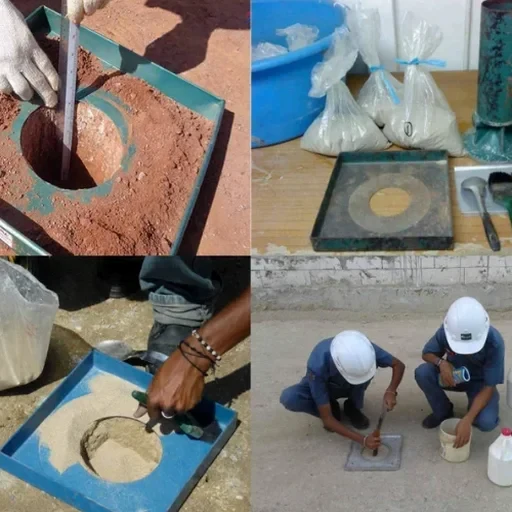
Backfill is placed in compacted lifts of 300 mm or less, typically using the excavated material unless it contains organics or oversized cobbles. The top 300 mm are finished with imported granular fill if the surface is to be paved or landscaped. Compaction is verified with a nuclear density gauge or sand cone test on every second lift to meet the 95% Standard Proctor density specified by the geotechnical report.

Can a test pit replace boreholes for a building permit application in Surrey?

Test pits provide excellent visual data for the upper 4 metres but do not replace the need for deeper boreholes when the City of Surrey’s building permit submission requires liquefaction assessment or bearing capacity verification below the pit bottom. Most projects use test pits to supplement SPT or CPT drilling—the pits calibrate near-surface conditions while the boreholes characterize deeper strata and seismic response.

Location and service area

We serve projects in Surrey and surrounding areas.

View larger map