GEOTECHNICALENGINEERING
SURREY
HomeGeophysicsElectrical resistivity / VES (Vertical Electrical Sounding)

Electrical Resistivity Surveys (VES) in Surrey BC

Technical studies that support your project.

LEARN MORE

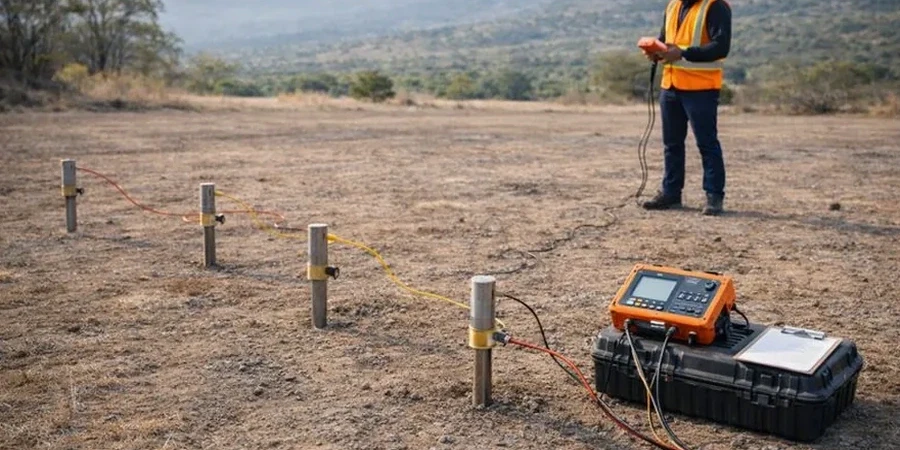
The ABEM Terrameter LS2 is the workhorse for deep resistivity sounding in Surrey. Four stainless steel electrodes push into the ground at expanding spacings—starting tight, then reaching out to 200 metres. The current flows. The potential drops. The resistivity stack builds. Surrey's geology is a puzzle of silty clays, peat lenses, and coarse glacial till. Direct push rigs get refused on cobbles. But an electrical sounding reads right through it. In Newton or South Surrey, we run Schlumberger arrays to map the salt wedge in the Semiahmoo aquifer. In Cloverdale, we target gravel channel boundaries for aggregate resource estimates. The data tells you what's below without turning a single shovelful of Surrey soil.

Resistivity contrasts map the contact between compressible Fraser River silts and competent Pleistocene till—a boundary that defines foundation costs in Surrey.
Our service areas

Our approach and scope

Surrey sits on the Fraser River floodplain, where 568,000 people live at elevations barely 10 metres above sea level. That flatness hides sharp transitions. Clean sand lenses give way to compressible organic silts within 30 horizontal metres. Vertical Electrical Sounding catches these boundaries. We inject current at stepped electrode spacings and record apparent resistivity. Then we invert the curve to true layer resistivities. A 15 ohm-metre layer might be saturated silty clay. A 200 ohm-metre layer signals dry sand or gravel. The method is non-destructive—no cuttings, no bentonite, no heavy access requirements. For preliminary site characterization, it often eliminates the need for a full grid of CPT soundings, especially across large Surrey parcels where drilling every 50 metres would blow the investigation budget.
Electrical Resistivity Surveys (VES) in Surrey BC
Technical reference — Surrey

Local ground factors

North Surrey's clay basins and South Surrey's upland gravels respond completely differently to electrical current. The clays near the Fraser hold water and read low—5 to 20 ohm-metres. The glacial deposits on the Semiahmoo Peninsula drain faster and read much higher. Misinterpreting a low-resistivity zone as groundwater when it's actually a conductive clay lens leads to over-excavation or the wrong dewatering plan. Worse, ignoring resistivity data in a subdivision near the Nicomekl River can mean missing a buried peat channel. Peat compresses under load. Foundations settle. The cost multiplies fast. A VES survey takes half a day. It costs a fraction of a drill rig mobilization. Yet it provides the stratigraphic framework that guides every subsequent borehole location and depth decision across the Surrey project footprint.

Need a geotechnical assessment?

Reply within 24h.

Email: [email protected]

Reference standards

BC Building Code 2024 (references NBCC 2020), CSA A23.3-19 (concrete structures context), ASTM D6431-18 (Standard Guide for Using the Direct Current Resistivity Method), ASTM G57-20 (Standard Test Method for Field Measurement of Soil Resistivity Using the Wenner Four-Electrode Method), CSA C22.3 No. 1 (corrosion context for buried infrastructure)

Technical parameters

ParameterTypical value
Array configurationSchlumberger (vertical sounding); Wenner (horizontal profiling)
Maximum depth of investigationTypically 60 to 100 m, depending on surface layer resistivity
Electrode spacing rangeAB/2 from 1.5 m to 200 m
Measurement range0.1 ohm-m to 1 Mohm-m
Typical Surrey near-surface resistivity5–50 ohm-m (clays/silts); 80–500 ohm-m (sands/gravels)
Data processing1D inversion (IPI2Win); 2D inversion (Res2DInv) for profiling lines
Reporting standardCSA A23.3 context; ASTM D6431 for field procedure

Frequently asked questions

What does an electrical resistivity survey cost in Surrey?

A single VES sounding typically runs CA$970 to CA$1,220. A 2D profiling line with 48 electrodes and multiple spreads falls in a similar per-line range, depending on length and access. We quote a fixed scope before mobilization—no hourly billing surprises.

How deep can VES see in Surrey soils?

Depth of investigation depends on the maximum current electrode spacing and the near-surface resistivity. In Surrey's conductive clays, a 200-metre AB/2 spread typically images 60 to 80 metres deep. In drier upland gravels, the same spread reaches 90 to 100 metres because less current leaks into the shallow layers.

Can resistivity distinguish between clay and silt?

Sometimes yes. Marine clays in Surrey often read 5–15 ohm-metres. Silts with higher sand content may read 20–40 ohm-metres. But resistivity alone cannot definitively separate the two—grain size and pore water salinity both affect the reading. We calibrate VES curves against at least one borehole or test pit log for lithologic control.

How long does a VES survey take on site?

A single Vertical Electrical Sounding with four electrodes and 25–30 spacing increments takes two to three hours of field time. A 48-electrode 2D profile along 200 metres takes about four hours. We process the data overnight and deliver inverted sections the next business day.

Location and service area

We serve projects in Surrey and surrounding areas. More info.

View larger map