GEOTECHNICALENGINEERING
SURREY
HomeLaboratoryLaboratory CBR test

Laboratory CBR Testing for Pavement Design in Surrey

Technical studies that support your project.

LEARN MORE

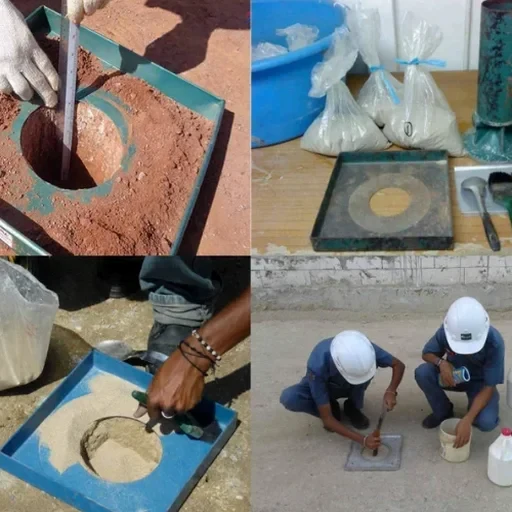
A recent infrastructure upgrade along 152 Street in Surrey revealed a common challenge: the native silty clays from the Semiahmoo and Fort Langley formations showed inconsistent stiffness. The project engineer needed reliable soaked CBR values before finalizing the structural pavement section. This is exactly the scenario where our laboratory CBR service becomes essential. By compacting remolded samples at target moisture and density—typically 95% of Modified Proctor per BC Ministry of Transportation specs—we simulate 96 hours of saturation to replicate worst-case field conditions. The load-penetration curve then reveals whether the subgrade can support design traffic without excessive thickness. Our Surrey-based team processes disturbed samples from across the Fraser Valley, from the upland tills of South Surrey to the compressible lowlands near Bridgeview, ensuring the pavement design accounts for real moisture sensitivity rather than optimistic dry assumptions. We complement the lab data with field density verification using the sand cone method when contractor compaction needs independent validation.

A soaked CBR of 3% versus 8% can mean the difference between 200 mm and 350 mm of asphalt on a Surrey collector road—moisture sensitivity drives the entire structural design.
Our service areas

Our approach and scope

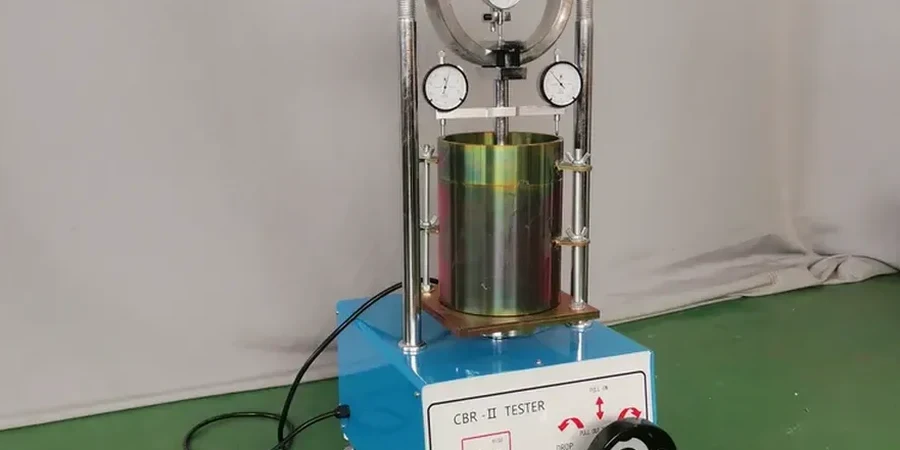
The test procedure we follow aligns with ASTM D1883, the standard referenced by Surrey’s engineering design criteria for municipal roadworks. Material passes through a 19 mm sieve before compaction in a 152.4 mm diameter CBR mold, using a mechanical rammer that delivers consistent 4.54 kg blows across five layers. What sets local projects apart is the high groundwater table across much of Surrey—especially in the Nicomekl and Serpentine River floodplains—making the 96-hour soaked test far more representative than unsoaked values. After soaking, we measure swelling directly from the dial gauge mounted on the tripod, then run penetration at 1.27 mm/min using a calibrated load frame. The corrected stress at 2.54 mm and 5.08 mm penetration, divided by standard reference stresses (6.9 MPa and 10.3 MPa), yields the CBR percentage. A value below 3% in saturated Surrey clays is not uncommon, which often triggers lime stabilization or a thicker granular sub-base to meet the 15% minimum typically specified for residential streets under BC Supplement to TAC guidelines.
Laboratory CBR Testing for Pavement Design in Surrey
Technical reference — Surrey

Local ground factors

Surrey’s population surpassed 568,000 in the 2021 census, making it BC’s second-largest city and fueling continuous road expansion. The Fraser River’s alluvial history left behind deep deposits of marine and glaciomarine silts with high natural water content, and when these soils are compacted and then saturated, the soaked CBR can drop by half or more compared to the as-compacted value. The risk of not running a proper soaked test is a pavement that performs well for two seasons and then rutts deeply after the first wet winter—something we have seen on older industrial access roads in Newton. Seasonal frost penetration, though shallow in Surrey compared to the Interior, adds another dimension: freeze-thaw cycles can remold the upper subgrade and further reduce bearing capacity. Combining the laboratory CBR with a flexible pavement design analysis ensures that the aggregate base and asphalt layers are thick enough to bridge weaker zones without excessive deformation over the 20-year design life.

Need a geotechnical assessment?

Reply within 24h.

Email: [email protected]

Reference standards

ASTM D1883-21: Standard Test Method for California Bearing Ratio (CBR) of Laboratory-Compacted Soils, ASTM D1557-12e1: Standard Test Methods for Laboratory Compaction Characteristics of Soil Using Modified Effort, BC MoTI Supplement to TAC Geometric Design Guide (Pavement Structural Design Section)

Technical parameters

ParameterTypical value
Standard ReferenceASTM D1883-21
Mold Diameter152.4 mm (6 in)
Compactive EffortModified Proctor (56 blows/layer)
Soaking Period96 hours submerged
Penetration Rate1.27 mm/min (0.05 in/min)
Surcharge Weight4.54 kg minimum annular mass
Typical Surrey Subgrade2%-8% soaked CBR in clays; 15%-40% in tills

Frequently asked questions

What sample quantity do you need for a laboratory CBR test in Surrey?

We typically require about 25 kg of disturbed material passing the 19 mm sieve. For fine-grained Surrey soils, a 20-liter pail is usually sufficient, but if the material contains gravel we recommend 35 kg to ensure enough fines fraction for proper compaction.

How much does a laboratory CBR test cost?

A standard soaked CBR on a single specimen ranges from CA$150 to CA$310 depending on whether it includes the companion Proctor compaction test and the number of moisture points requested. A three-point CBR curve with compaction data is at the upper end of that range.

Why is the soaked CBR more relevant than unsoaked for Surrey?

Surrey’s high water table in areas like Cloverdale and the Serpentine lowlands means subgrade soils often approach saturation during the rainy season. The 96-hour soak simulates this worst-case scenario, and design based on unsoaked values frequently underestimates pavement thickness, leading to premature rutting.

Do you test both subgrade soil and granular base materials?

Yes. We run CBR on fine-grained subgrade, but also on crushed granular base course per the BC MoTI specification. The procedure adjusts the compaction effort and surcharge mass accordingly, and the penetration curve for granular materials typically yields CBR values above 80% when well-graded.

How does the lab CBR value relate to field CBR from a DCP test?

Field DCP gives an in-situ CBR profile, while our lab test provides the soaked remolded value at controlled density. We often recommend correlating both: the lab value defines the design lower bound after saturation, and the DCP identifies weak layers in the existing pavement or subgrade before reconstruction.

Location and service area

We serve projects in Surrey and surrounding areas.

View larger map